Custom Beanie & Headwear Customization on Shopify
Custom beanie and headwear personalization for Shopify. Embroidery, color picker, and live preview setup for hat and beanie brands.
Custom Beanie & Headwear Customization on Shopify
The beanie market is booming. From corporate teams stocking branded winter gear to nonprofits fundraising with custom headwear, demand for personalized beanies spans workwear, sports, events, and retail merchandise. If you're building a Shopify store around custom beanies, you need to understand both the technical setup and the production realities that make or break the customer experience.
This guide walks you through everything: beanie styles worth offering, customization methods that actually work, Shopify configurator workflows, supplier options, and how live preview transforms your conversion rate.
Why Custom Beanies Matter
Beanies occupy a sweet spot in custom apparel. They're affordable enough for impulse buys ($12–$35 retail) but premium enough to command decent margins with personalization. Unlike t-shirts or hoodies, beanies don't require complex size grading—most are one-size-fits-most or simple S/M/L variants.
Key markets driving demand:
- Corporate & workwear: Construction crews, ski patrol, outdoor teams need branded cold-weather gear.
- Sports & teams: Youth hockey, running clubs, college organizations buy beanies in bulk.
- Brand merchandise: Influencers, podcasters, and indie brands use beanies as affordable merch SKUs.
- Holiday & seasonal: Event organizers, nonprofits, and retailers stock custom beanies for winter fundraising.
The beanie's small, visible canvas makes customization feel high-value while staying cost-effective to produce.
Beanie Styles to Offer
Your style mix dictates production complexity and appeal. Here are the core options:
Cuffed Beanies The standard. Ribbed knit with a folded cuff at the base. Versatile, affordable, easy to customize across the crown or cuff band. Works for embroidery, labels, and heat transfer.
Slouchy Beanies Longer, roomier fit that sits back on the head. Popular in streetwear and luxury segments. Offers more surface area for embroidery (larger embroidery placement on the back panel).
Pom-Pom Beanies Decorative pom on top. Adds perceived value. Customization typically goes on the cuff or lower crown; the pom is rarely personalized.
Fisherman Beanies Thicker, more textured knit. Rugged aesthetic appeals to outdoor and workwear markets. Embroidery placement is critical since heavier knit limits detail.
Fleece-Lined Beanies Interior fleece lining boosts comfort and price point. Popular for corporate gifting and outdoor sectors. Customization options remain the same, but production lead times may be longer.
Start with 2–3 styles (cuffed + slouchy minimum) and expand based on order data.
Customization Methods: When to Use Each
Not all beanie customization is created equal. Different methods suit different use cases, budgets, and quality expectations.
Embroidery
What it is: Thread stitched directly into the knit fabric. Creates a raised, tactile finish.
Best for: Logos, monograms, team names, small text. Anything requiring durability and a premium feel.
Advantages:
- Durable—threading lasts the life of the beanie.
- Professional appearance; customers expect it on branded gear.
- Works with color blends (multi-thread designs).
- No additional garment handling beyond stitching.
Limitations:
- Detail limits: typically 5,000–15,000 stitches per design, depending on your supplier's setup.
- Large or complex logos need simplification.
- Embroidery pulls knit fabric slightly, so placement matters (avoid edges).
Production specs: ask the embroiderer for the accepted artwork and machine-file formats, minimum text and line sizes, thread palette and digitization requirements for the exact beanie. There is no universal quarter-inch stitch-spacing rule.
Leather Patch
What it is: Custom leather (or faux-leather) label sewn or heat-applied to the cuff or side panel.
Best for: Minimalist branding, luxury positioning, designs with fine detail.
Advantages:
- Allows photo-quality detail (no stitch count limits).
- Premium perceived value.
- Works at small scale—even a 2×2 inch patch looks polished.
- No fabric stress from stitching.
Limitations:
- Higher cost per unit than embroidery.
- Requires custom die-cutting (setup fees).
- Lead time depends on leather sourcing.
Production specs: High-resolution artwork (300 DPI minimum); vector files for clean edges; specify patch dimensions and attachment method (sew vs. heat-applied).
Woven Label
What it is: Custom-woven fabric label, similar to leather patches but textile-based.
Best for: Brand tags, heritage-style marks, complex multicolor designs.
Advantages:
- Handles intricate color work and gradients better than embroidery.
- Lighter and softer than leather.
- Professional, heritage brand aesthetic.
Limitations:
- Higher cost than embroidery; lower cost than premium leather.
- Setup fees and minimum order quantities.
- Placement typically limited to cuff or inner label area.
Production specs: RGB artwork converted to pantone; specify weave density; indicate label dimensions.
Sublimation Printing
What it is: Dye-based printing onto synthetic knit or coated fabric. Heat and pressure bond ink to fibers.
Best for: Full-color, photorealistic designs; detailed gradients; edge-to-edge prints.
Advantages:
- No stitch count or detail limits.
- Handles photographs and artwork without simplification.
- Fast turnaround for digital print.
Limitations:
- Only works on synthetic knits or pre-coated beanies.
- Colors fade slightly over time (not as durable as embroidery).
- Doesn't work on 100% wool or high-end natural fibers.
Production specs: use the supplier’s required format, pixel dimensions, color profile and bleed for the exact blank. Do not assume every sublimation supplier wants CMYK.
Heat Transfer Vinyl (HTV)
What it is: Heat-pressed vinyl or plastisol transfer applied to the beanie surface. Direct-to-garment printing is a separate process and is usually a poor fit for knit beanies, so treat HTV as the practical low-volume transfer option.
Best for: Photo prints, multicolor artwork, complex designs at low volume.
Advantages:
- Inexpensive setup (no die-cutting or weaving).
- Full-color capability.
- Suitable for one-off custom orders.
Limitations:
- Durability concerns on knit fabric (transfers can crack with washing/stretching).
- Stiff feel compared to embroidery.
- Not ideal for premium positioning.
Production specs: PNG with transparent background; specify transfer method (vinyl vs. plastisol); note care instructions to customers.
Setting Up Your Beanie Customizer on Shopify
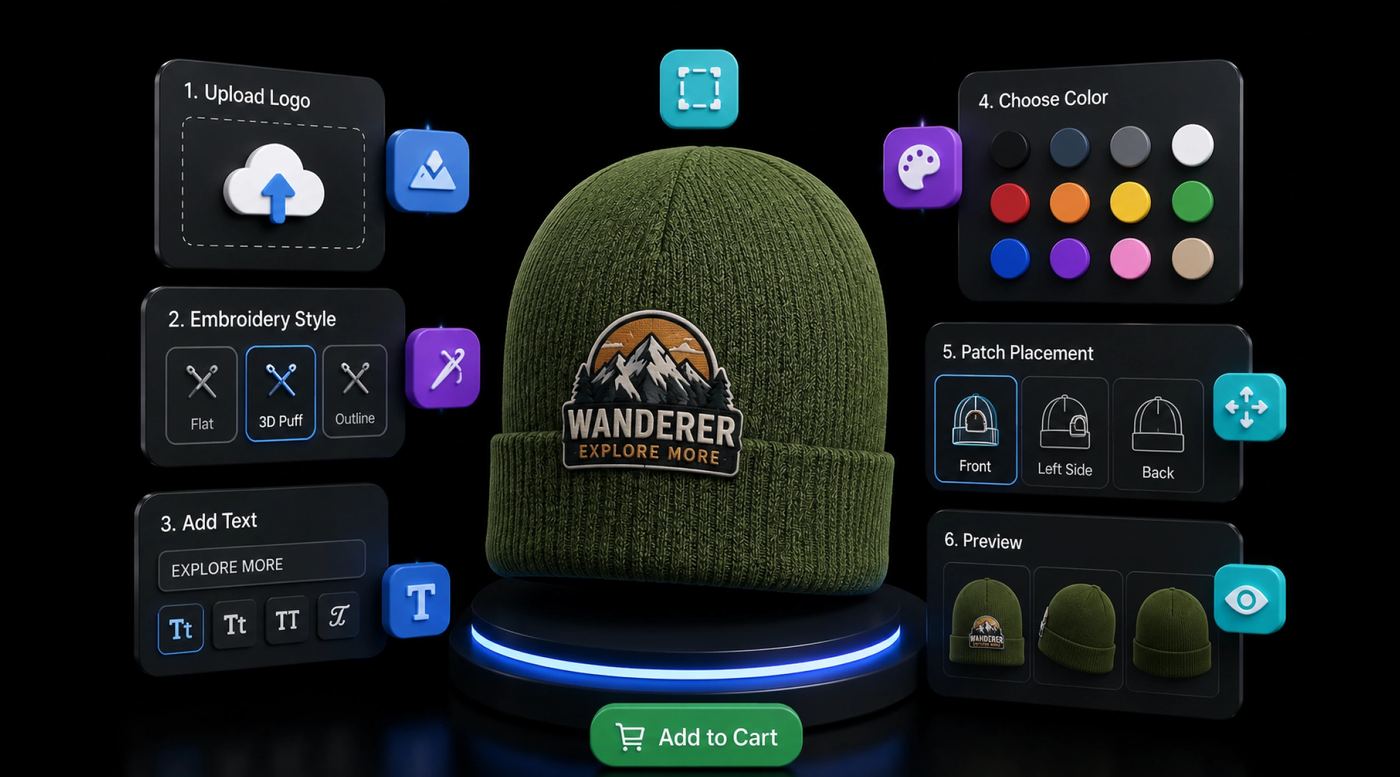
A well-designed customizer removes friction and increases confidence. Here's the ideal configurator flow:
Step 1: Choose Blank Beanie
Customer selects beanie style (cuffed, slouchy, etc.) and color from available inventory. This scope is crucial—limit to 3–5 popular colors initially. More options = longer production and higher complexity.
Shopify implementation: Use product variants for each style/color combo. Display a high-quality 360° photo or video of the blank beanie.
Step 2: Choose Customization Method
Present the main options: embroidery, leather patch, woven label, sublimation, and optionally heat transfer for low-volume orders. Include a brief description and typical lead time for each.
Key UX note: Don't overload. Start with embroidery + sublimation. Add leather, woven labels, or heat transfer once your volume justifies the supplier relationships.
Step 3: Upload Artwork or Enter Text
- For embroidery: Text input + simple logo upload. Accept JPG, PNG, or PDF.
- For leather/woven: Artwork upload with dimensions specified.
- For sublimation: Full image upload with clear guidelines on bleed and dimensions.
Include a file specs section: "Embroidery accepts DST files or high-res artwork (300 DPI). Typical max logo area: around 3×4 inches on the crown or 2.25×4 inches on the cuff."
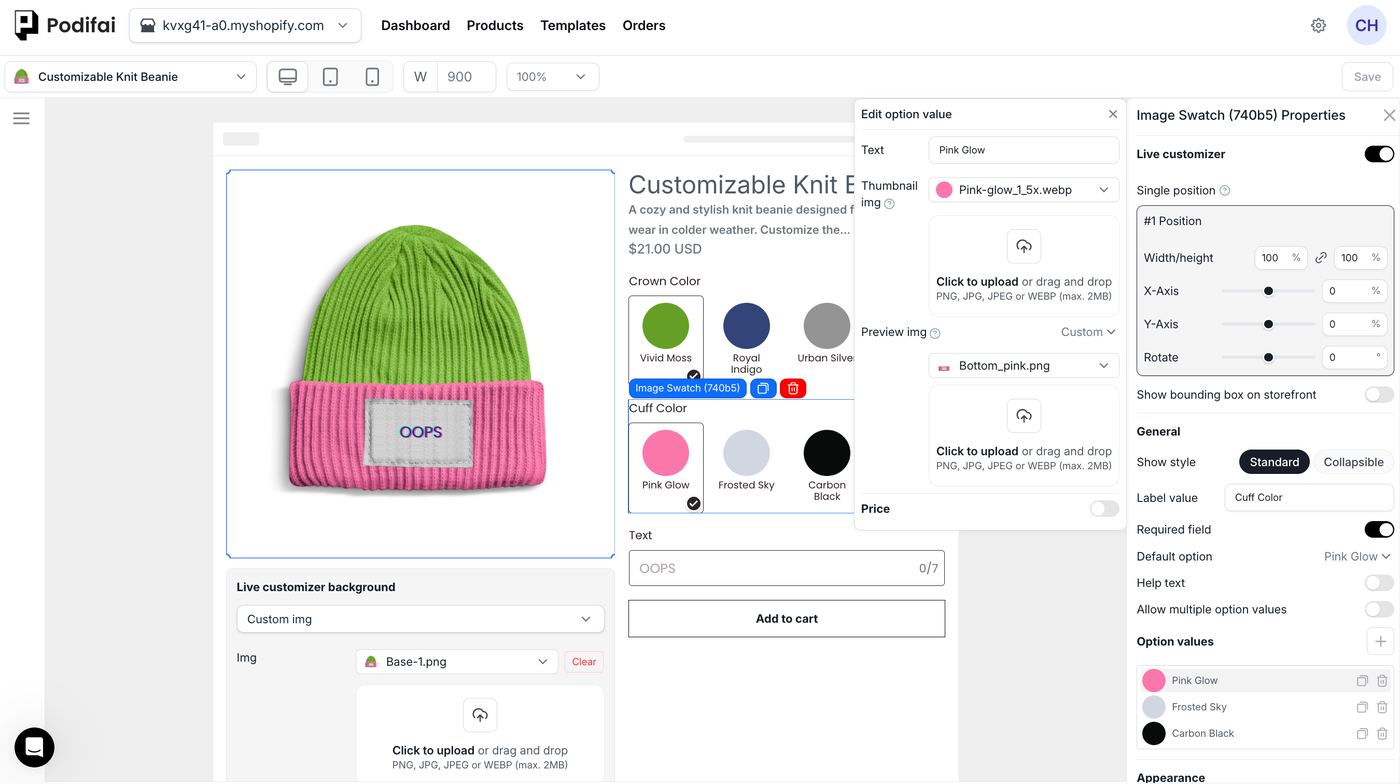
Step 4: Live Preview
Use a preview to show the supported placement choices on the actual beanie image. Podifai uses layered 2D views; a preview does not verify stitching, fabric behavior or production suitability.
- Exact placement on the cuff, crown, or side panel.
- How the design interacts with the beanie's texture and curve.
- Thread colors (for embroidery).
Why it matters: Embroidery placement mistakes are expensive. A customer who previews and approves the placement won't claim the order arrived "wrong."
Learn how live preview can boost confidence and reduce returns
Step 5: Review & Checkout
Display a summary: beanie style, color, customization method, design, and estimated lead time. Include production-time disclaimer ("Orders ship within 5–7 business days after customization approval").
Include a final design-review step before production. Customer approval helps clarify the requested design but does not replace the merchant’s quality-control checks.
File Specifications by Customization Method
Supplier mistakes are usually file-related. Be explicit.
Embroidery Files
- Formats: DST, PES, JEF, EXP (check with your supplier).
- Stitch count: 5,000–15,000 stitches depending on detail.
- Minimum spacing: obtain minimum line thickness and spacing from the embroiderer for the selected font, design size, thread and fabric.
- Color: Specify exact thread colors by Pantone or supplier color code.
- Size: Around 3×4 inches on the crown or uncuffed body; around 2.25×4 inches on the cuff. Confirm hoop and edge-clearance limits with your embroiderer.
- Resolution: Not applicable (vector/stitch-based), but source artwork should be 300 DPI.
Leather Patch
- Artwork: Vector (AI, EPS) or high-res raster (300 DPI PNG/JPG).
- Color: use the file color profile requested by the patch supplier. Confirm material and color with a sample.
- Dimensions: Specify exact patch size (e.g., 2.5×1.5 inches).
- Attachment: Sew (grommet holes) or heat-applied (outline thermal bond).
Woven Label
- Artwork: Vector or 300 DPI raster.
- Color space: RGB, then convert to pantone by supplier.
- Weave density: Specify thread count (200D, 300D typical).
- Size: 3×1 inches max (most woven label looms).
Sublimation Print
- Format: PNG with transparent background or PDF.
- Resolution: 300 DPI minimum.
- Color space: follow the exact supplier template; do not convert automatically to CMYK unless requested.
- Bleed: use the supplier’s required bleed and safe area for the exact blank and process.
- No white: Sublimation cannot print white; use beanie color as white.
Beanie Supplier Landscape
You'll need two supplier relationships: blank beanies and customization services.
Blank Beanie Sourcing
Options:
- Major wholesalers (Alibaba, trade shows): Bulk minimums 50–500 units per SKU. Research current wholesale rates in your market; rates fluctuate with material and order volume.
- Print-on-demand networks (Printful, Spring, formerly Teespring): Higher per-unit cost, zero minimums. Good for testing styles before committing to bulk orders.
- Direct factories: Long lead times, best for 500+ unit orders. Requires supplier vetting and payment terms negotiation.
Customization Services
Embroidery:
- Local embroidery shops (fast, personalized, good for urgent orders or complex designs).
- Online POD platforms with embroidery (Printful, Embroidery.com).
- Check turnaround times and stitch limits before committing.
Leather/Woven:
- Specialty label suppliers (research current rates; expect per-unit costs to vary by patch size and material).
- Usually require design approval and sample production before bulk runs.
Sublimation:
- Print shops with textile capabilities.
- Often handle fulfillment in-house, which simplifies your workflow.
Key sourcing principles:
- Test suppliers with 10–50 unit trial orders before promoting heavily.
- Document lead times and hold suppliers accountable.
- Build relationships with 2 suppliers per method (backup if one fails).
- Communicate realistic delivery windows to customers based on supplier performance.
Common Use Cases to Target
Tailor your marketing to these high-intent segments:
Team & Corporate Gifts Coaches, HR managers, event organizers buy beanies in bulk. Emphasize bulk discount tiers and fast turnaround. Create a landing page for "Team Beanie Orders" with group order workflows.
Brand Merchandise Podcasters, streamers, indie brands need affordable merch. Highlight low minimums (even single-unit custom beanies) and brand-building potential. Offer sample beanies at cost to influencers.
Holiday Fundraising Nonprofits and schools run winter campaigns. Position custom beanies as low-risk, high-margin fundraising items. Provide templates and marketing assets.
Employee Recognition & Incentives Companies use branded beanies as employee swag. Target HR managers and operations teams with bulk pricing and customization simplicity.
Event & Concert Merchandise Music festivals, conferences, and sporting events sell branded beanies on-site and online. Emphasize fast production and inventory flexibility.
Why Live Preview is Essential for Beanies
A beanie’s curved, textured surface makes placement important. Use a photograph of the actual blank and confirm the final design with the embroiderer.
A customer who orders a beanie with "ACME CORP" embroidered on the crown expects that text centered and visible when worn. Without a preview, they might think placement is on the front cuff, not the back. They get the order, it's "wrong," and you process a return.
Live preview solving this:
- Shows the beanie from front, side, and back angles.
- Shows supported placement choices on the prepared product images; it is not an exact 3D or stitch simulation.
- Lets shoppers switch between prepared views where configured; native 3D rotation requires a separate supported system.
- Reduces return claims and disputes.
Read more on Podifai's live preview feature
The cost of a preview tool or custom mockup workflow can be offset quickly if it prevents even a few remake or return claims in your first batch of orders.
FAQ: Custom Beanies on Shopify
1. Can I customize beanies with multiple thread colors for embroidery?
Yes, but with limits. Embroidery supports color transitions within a single design. However, each color change adds stitch time and cost. Most suppliers recommend 2–4 thread colors per design for beanies. Discuss color changes with your embroidery partner upfront.
2. What's the maximum stitch area for beanie embroidery?
Most beanie embroidery fits within roughly a 3×4 inch area on the crown or uncuffed body, or around 2.25×4 inches on the cuff. Larger designs require repositioning or multi-step embroidery, which raises cost. Confirm limits with your supplier; some use smaller hoops and charge a premium for larger placements.
3. What's the minimum order for custom beanies?
If using POD suppliers, 1 unit. If ordering blanks + customization in-house, minimums depend on your suppliers. Blank minimums often start around 50–100 units, while larger wholesalers or factories may require 200–500 per SKU. Customization services vary. Some embroiderers accept 5–10 unit runs; others require 25+. Set customer expectations early (e.g., "Single custom beanies available; bulk orders (10+) receive 15% discount").
4. How long does custom beanie production take?
Typical turnaround: 5–7 business days for embroidery or sublimation after design approval. Leather patches and woven labels add 2–3 days due to material sourcing. Communicate production timelines clearly at checkout. Offer rush options (48-hour turnaround) at a premium if your suppliers support it.
5. What file formats should I request from customers?
For embroidery: DST, PES, JEF, or high-res artwork (PNG/JPG 300 DPI). For leather/woven: Vector (AI, EPS) or high-res raster. For sublimation: PNG with transparent background or PDF. Include a help article with file specs on your website so customers submit correct formats on first try.
6. Do custom beanies have return policies?
Yes, but customized items are typically non-returnable due to personalization. Clearly state this in your terms: "Custom embroidery/printed beanies are final sale due to personalization." Offer design approval steps and live preview to prevent dissatisfaction. If a mistake is your fault (wrong color thread, misplaced logo), offer a replacement or refund as goodwill.
7. How do I handle sizing for custom beanies?
Most beanies are one-size-fits-most. If offering S/M/L variants, note that customization placement might differ slightly by size. Create a size chart with actual measurements and a preview showing how the beanie sits on different head sizes. Minimize size-related returns by being explicit about fit.
8. Can I match thread colors to customer-provided color samples?
Embroidery thread is limited to industry-standard colors (Pantone, Madeira, Isacord, etc.). You cannot perfectly match an arbitrary hex color or photo sample. Provide a color swatch or Pantone guide and ask customers to choose from available threads. State this upfront: "Custom thread colors are selected from our supplier's palette; we'll recommend the closest match to your requested color."
Bringing It Together: Your Beanie Store Launch Checklist
- [ ] Select 2–3 beanie styles and secure blank inventory.
- [ ] Partner with an embroidery supplier; test with 10-unit trial orders.
- [ ] Add a secondary customization method (sublimation or leather patch) once embroidery is stable.
- [ ] Build the Shopify configurator with product variants for each style/color.
- [ ] Implement live preview mockups (use Podifai or a similar tool).
- [ ] Create detailed file specification guides and add to your knowledge base.
- [ ] Write landing pages targeting team orders, nonprofit fundraising, and brand merch.
- [ ] Set clear lead times and communicate them at every step.
- [ ] Run a 5-unit test order through your full workflow and document any friction.
- [ ] Launch with social proof (testimonials, case studies, before/after).
Learn More
Explore Podifai's full customization toolkit:
- Shopify Product Customization Overview
- Design Your Own Hat on Shopify
- Polo Shirt Customization Setup
- Live Preview for Confidence & Conversions
Custom beanies are a high-margin, low-complexity entry point into personalized apparel. Start small, iterate on supplier quality, and scale what works.